


SNOWBOUND IN '79
Happy Holidays everyone! Here's hoping the last couple of days have been exceptional, loaded with special people and memories of those who have enriched and shaped your life!
Personally, I am spending time with family in Bloomington, Illinois. Due to the fact my wife says I need to be more involved with the family, this is a recap of January 1979, the worst overall month of winter weather regionally in modern history. Filled with bitter cold, tons of snow, and an epic blizzard, it remains one for the ages.
The Quad Cities blizzard of the century:

The worst snowstorm in Quad City history:

47 years ago this January 13th, much of the Midwest was digging out from one of the worst blizzards in history. In the Quad Cities, an all-time record 18.4″ of snow fell during the wind driven storm.

Route 5 E. Moline, courtesy QC Times
Coming on top of the 10″ already on the ground, the blizzard brought the city to its knees. Drifts up to 8′ closed every artery leading in or out of town, including interstates 80 and 74! To this day, the 28″ snow depth following the storm is the greatest ever measured in the Quad Cities.
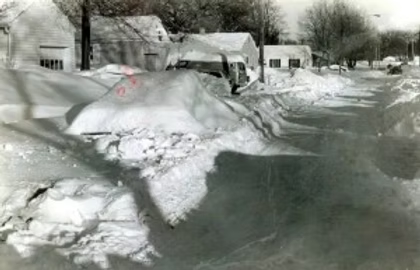
A scene near South Nevada and Michigan avenues, Davenport. Quad-City Times photo by Kris Jensen


Downtown Davenport, 1979, courtesy Quad City Times
An interesting side note to the blizzard. Weather models and forecast accuracy were not what they are today. Less than 24 hours before the first flakes began to fall, the NWS issued a travel advisory with a forecast of 2-4″ of snow. Needless to say, that one didn’t work out!

SAME BLIZZARD, JUST AS BAD IN CHICAGO
Not to be out done, Chicago had a similar experience. The storm started on the night of Friday, January 12th and left 20 inches of snow over the weekend on top of a base of seven to ten inches. It closed O’Hare – the world’s busiest airport – for 46 hours.
The blizzard itself ravaged areas from the Rockies to the Great Lakes and left at least 99 dead. In Iowa, National Guard helicopters brought in 75,000 pounds of hay to starving cattle. Similar efforts were made throughout NW Illinois. In Chicago, roofs collapsed from the weight of the snow, and transportation was brought to a standstill for nearly a week. Garbage trucks were unable to run, and the rats took advantage. The salt used to de-ice the roads caused motor failures on some of the trains. Abandoned cars slowed snow removal efforts. Buses were at least two hours behind schedule, if they were running at all. After six days, only half of the runways at O’Hare were open for traffic.

Chicago January 14th, 1979-courtesy Chicago Tribune
The storm even had political ramifications. With train lines snowbound, roads impassable, and buses stalled, many walked miles past the point where nothing could roll but plows. The blizzard stopped the city in its tracks, leaving mountains of snow the size of apartment buildings and giving the place a feel of being under siege. It also cost the mayor his job. While the streets were fit only for plows, the plows didn’t come. Democratic candidate for mayor, Jane Byrne, started talking to reporters and TV crews in front of unplowed streets, asking how Mayor Michael Bilandic could fail to do this basic part of his job. The message stuck, and Byrne was able to use the impact of the frozen mess to build a larger picture of Bilandic’s City Hall as another kind of mess. In spring, she became the city’s first female mayor.
In summation, I’m 70 years old and have lived in eastern Iowa my entire life. For the amount of snow, the high winds (40-50mph), and bitter cold, this was the worst I’ve ever seen. I-80 was closed from Des Moines to Chicago, and it took nearly a week to get all the stranded cars and trucks out of the interstate and ditches.
I can remember drifts 10-15′ high on some of the north-south roads. In spots, you had to drive through tunnels that were cut out like a piece of cake. I remember helicopters dropping supplies and bales of hay to stranded farmers and livestock. Iowa and Illinois made the national news night after night. As harsh and inconvenient as it was, it was a bonding experience that brought people together. We all remember where we were and what we did to help each other and survive the blizzard of ’79.
Blizzard survivor t-shirts became a popular item-courtesy QC Times

In the end, the winter of 1978-1979 will long be remembered not only for heavy snow, but bitterly cold temperatures. A winter season record (December through February) 52.9 inches of snow fell, and the average temperature over the same period was an all-time low of 14.1 F.
January itself, was a record-breaking month in terms of both snowfall and arctic cold temperatures. From January 12th to the 14th, the blizzard dumped an estimated 18.4 inches of snow. This was a record amount for a single snowstorm. A record 26.7 inches fell during the month of January, while the snow depth was a record 28 inches from January 14 through the 19th.
Besides being a month for record snow, January was also the coldest month ever in the Quad Cities. The average temperature was only 6.3°F. Beyond that, when the temperature dropped to 27°F below zero January 2nd, it was the second-coldest reading ever measured in the Quad Cities.
When it comes to getting your bang for the buck, January was one of the all-time great weather months in Quad Cities history, being both the coldest and snowiest of all-time. We haven't seen a month like it since, and I am proud to say I remember (and survived) the winter of '79. Roll weather...TS


Me too, My brother and I had a Case backhoe and an old Chevy 5 ton dump truck. We hauled snow from streets and parking areas to the Muscatine river front for days. Big loaders pushed the snow out on the river ice to make more room. Thanks for the recall.